FRANCES HODGKINS
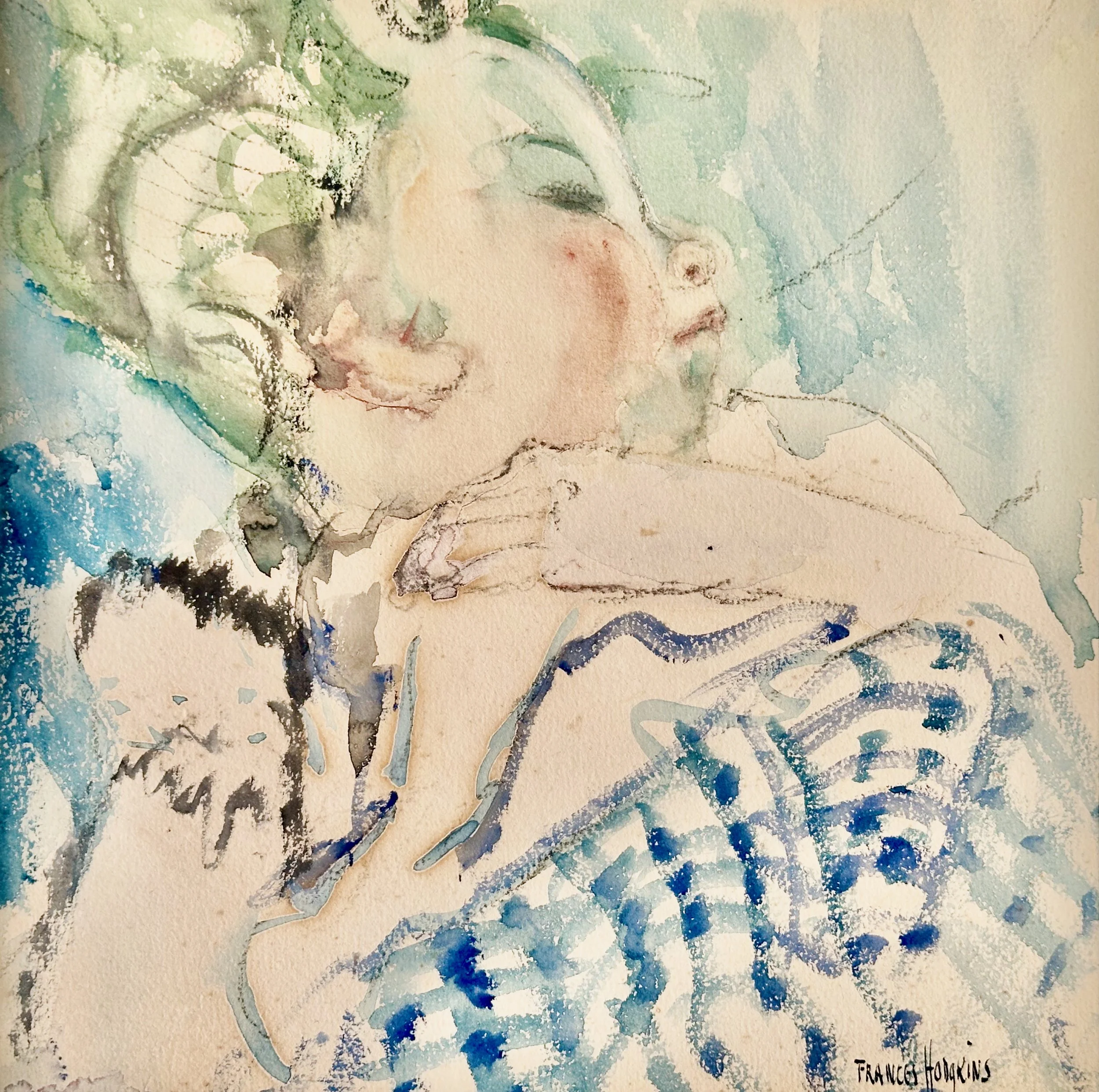
Child Asleep c. 1918
Watercolour, 26 x 26 cm
Signed FRANCES HODGKINS lower right
From Frances Hodgkins to Rachel Hodgkins. Wharf Studio St Ives Sept 18th 1918
My Dearest Mother … I heard from the International Society that they would give me a wall to myself for my Water Colours at the coming show next week. This caused some flutter, but luckily most of them were finished. They are small pictures mostly at easy prices – all babies & Mothers & children. Sort of Infant Welfare idea if you can stretch the point so far – as attractive as I could make them. I gave the Mothers (5) and their offspring (numerous) a tea party at the Hotel before I left. Such fun – they were so nice & blushing & shining over it all got up regardless. Dear women all of them with husbands fighting & one a prisoner who had never seen his beautiful baby. One of them brought me 2 lbs of blackberries & another broad beans, so broad they might have been marrows. I found afterwards kind Mrs Cox the landlady had given me the party for nothing, as I had given her a sketch of her child & she was grateful.
Between 1917 and 1918, in the final years of the First World War, Frances Hodgkins was living in the Cornish coastal town of St Ives. Artists who had traditionally worked en plein air were compelled to move indoors under War Department restrictions, making studio portraiture both practical and commercially viable. In 1916, while living in Chipping Campden, Hodgkins had already begun a series of small watercolour portraits of babies when bad weather kept her inside. Now in St Ives, restricted once again, this time by wartime mandate, and reliant on portrait commissions to supplement her modest teaching income, she continued her intimate studies of mothers and infants. In March 1918 she wrote wryly to her brother-in-law William:
What I want is a small & tidy income so that I need not have to fight for daily bread. Truly living is a fine art these days. Yesterday I sold a 12 guinea baby. Item: Paint more babies!
In Child Asleep (c.1917), Hodgkins’ handling of watercolour is especially expressive. Transparent washes in a cool-toned palette bleed softly into one another, creating an atmosphere of intimacy and transience. Warmth is concentrated in the child’s flushed cheeks, while the setting is suggested rather than described: the checked blanket, crisp sheets, and surrounding space emerge through rhythmic marks and passages of colour, with the whiteness of the textured paper. Form is conveyed through tone and gesture rather than firm delineation, signalling her increasingly modern sensibility.
The child’s softly modelled face anchors the composition, while the painterly abstraction of the background heightens the stillness of sleep. Hodgkins captures not only a likeness but also a mood; a fleeting moment of calm that stands in poignant contrast to the wartime uncertainty beyond the domestic interior.
Hodgkins’ repeated return to babies and young children during these years was not merely a matter of convenience, but part of a broader shift in her artistic circumstances. With war limiting travel, exhibition opportunities, and outdoor work, the domestic sphere offered both subject matter and economic survival. Infants, in particular, embodied ideals of innocence and continuity at a time when European society was marked by loss and upheaval.
At the same time, the informality of these “baby pictures” afforded Hodgkins space to experiment. Unlike more formal commissioned portraits, her studies of sleeping or resting children favour atmosphere over exact likeness. They become exercises in colour harmony, soft modelling, and the expressive possibilities of watercolour. Outwardly modest domestic images, these works occupy an important position within her development, contributing to the increasingly modern character of her art while also providing a measure of financial security.
In Child Asleep, Hodgkins transforms portraiture into something more than professional necessity. The subject may have been marketable, but the result is deeply personal: a meditation on innocence, stillness, and refuge. In wartime Britain such images carried particular resonance, offering reassurance through the familiar intimacy of home. Some of the children depicted in these St Ives portraits had never been seen by their fathers, absent on military service. The painting stands as both a tender study of childhood and a subtle reminder of art’s restorative power in troubled times.
Provenance
Mr & Mrs Esmond Atkinson, Wellington,
(Gift from Frances Hodgkins)
Private Collection, Auckland by inheritance from
Mr & Mrs Atkinson
Literature
E H McCormick, Works of Frances Hodgkins in New Zealand, (Auckland City Art Gallery, Auckland, 1954) p. 195
Reference
Frances Hodgkins database (FH0607) www.completefranceshodgkins.com